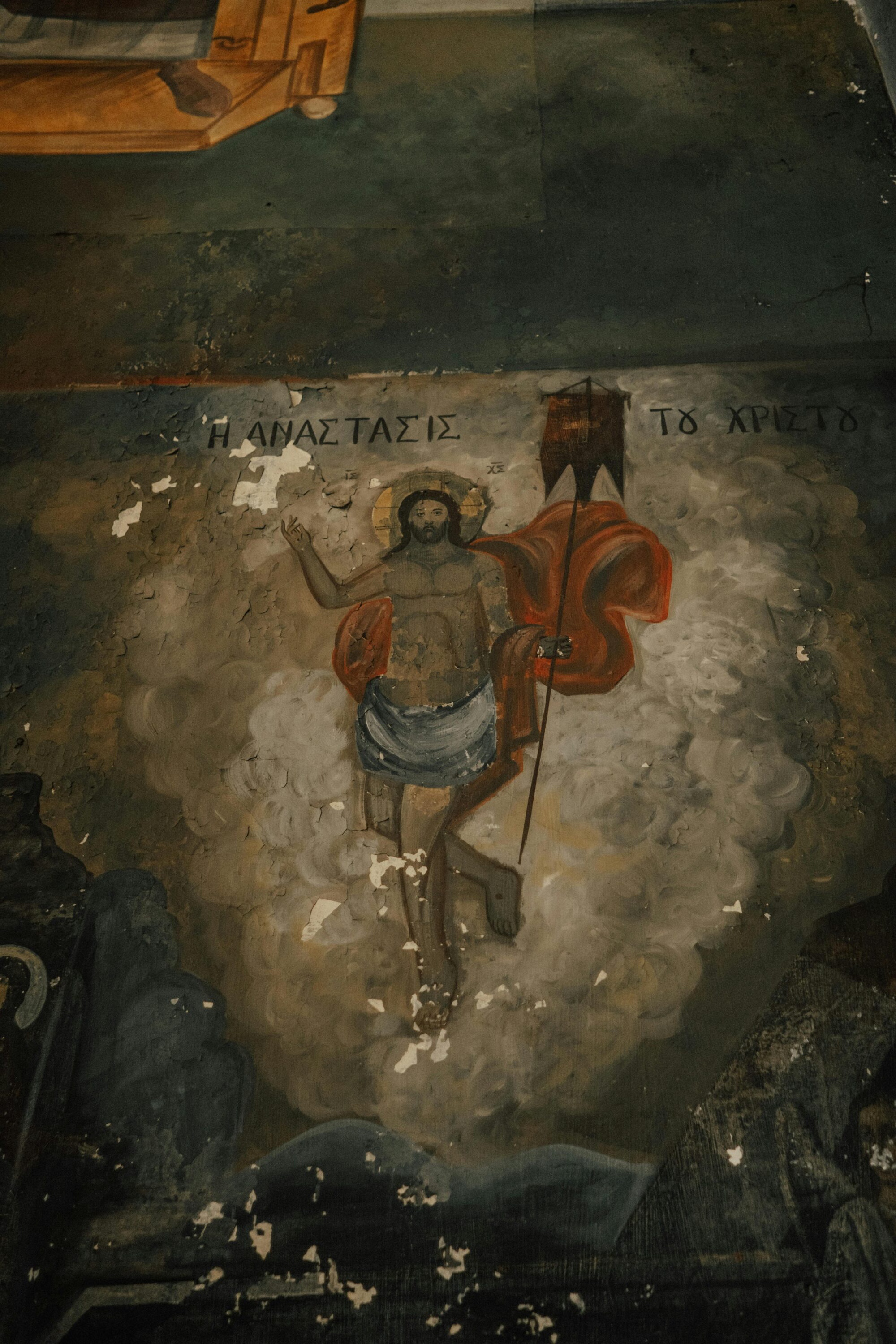
This is a sermon that I preached on Sunday, 04/05/26, at Berkeley Friends Church. The scripture reading for this sermon was: Mark 16:1-8; John 20.
Two weeks ago I preached on Jesus’ resurrection of Lazarus. In that sermon I explored the idea of theodicy, the problem of why evil exists in the world when we know that God is both good and all-powerful. In the story of Lazarus, we explored what it looks like to see God entering into our suffering and, instead of blaming and figuring out who is guilty for the existence of evil, focusing on God’s answer to evil. God enters directly into the cosmos out of love for us and a desire to rescue us.
This morning we are celebrating another resurrection. This resurrection is particularly special because after Lazarus was resurrected, he eventually died again. The resurrection we celebrate this morning is a permanent resurrection. This resurrection does not simply restore ordinary biological life; it transforms Jesus into something entirely new. This new life has defeated sin, death, and hell once and for all. In this resurrection, we find a definitive resolution to the problem of evil.
This is the linchpin of the Christian faith. Without the reality of the resurrection, the Christian religion simply couldn’t hold together. A Christianity that ends with Jesus dying on the cross and being buried and being dead in the same way that every other crucified criminal before him fails to resolve the problem that Jesus came to confront.
The resurrection is a really good story. It feels true to me. But it’s not enough for Christianity to be a good story. It’s not enough for Christianity to be morally true. It needs to be factually true.
The central truth claim of the early church was that Jesus Christ was crucified, died, and was buried, and that after three days he rose from the dead. Hundreds, perhaps even thousands of early Christians, had personal experiences of Jesus appearing to them, speaking to them, guiding them, eating fish with them. Whether or not you believe in the literality of these truth claims, the early church clearly considered it essential. It was absolutely what they were proclaiming. It was what they were building their lives around. The resurrection of Jesus is the reason that Christians were willing to die for their faith in the early centuries of the Christian church in a hostile pagan empire.
This is a problem for me, because I’ve never seen someone be raised from the dead. That’s not a part of my experience. And that would be okay if the resurrection were a metaphor, if what the early church was saying was that Jesus rose spiritually from the dead. I could make sense of that. That would compute.
But that’s not the central truth claim that the early church made. They said, “No, you don’t understand. Jesus is literally alive. He rose from the dead and he’s a new kind of human. He’s completely whole. He’s completely fulfilled. He is transformed. He is the image of the invisible God, the first born of all creation. He is The Man. He is alive. He ate fish with us! We touched his wounds and put our hand in his side.”
I haven’t eaten fish with Jesus. I haven’t touched his wounds. In the Gospel of John, Jesus says, “Blessed are those who have not seen and yet have believed.” And I do. I do believe, even in spite of all my doubt.
John went to great lengths in his gospel to address the issue of doubt. He specifically has Jesus saying, “It’s okay if you don’t see me. In fact, you’re even more blessed if you believe without physical evidence.” John’s gospel is generally believed to be written decades after Mark. By the time John is writing his gospel, clearly there’s already an issue among the believers in the early church that not everyone has had a personal experience with the embodied Jesus. A couple of generations after the resurrection, a lot of the newer disciples are going to have to take the elder disciples’ word for it.
That seems like the situation we’re in now too. As far as I can tell, Jesus no longer appears bodily to us. Apparently that stopped after he ascended into heaven at the end of the forty days, which Luke narrates at the beginning of the book of Acts. After a period of physical presence with the disciples, the modality in which Jesus was operating shifted again. John’s gospel explains why this is: He says that it’s to our advantage that he go away so that the Holy Spirit will come and teach us everything and lead us into all truth. With the Spirit, we will do even greater things.
That’s exactly what we see in the book of Acts. Not long after Jesus ascends into heaven and stops appearing bodily to the disciples, they are filled with the Holy Spirit on the day of Pentecost. With the arrival of the Holy Spirit, the disciples moved into a whole new kind of life, actively participating in the resurrection. Just as Jesus promised, he became the vine and they became the branches, knitted together in the Holy Spirit. The community of disciples became an organic unity with one breath. They became the body of Jesus in this world.
According to the Bible, we are the evidence of the resurrection. We are his holy temple. We are the dwelling place of his Spirit. We are the body of Christ, and individually members of it.
Jesus is alive. The resurrection is real. It is not just a metaphor. It really happened and it is still happening. The resurrection is God’s intention for all of humanity. A transformation that makes us into something totally new, utterly alive, entirely full of God’s spirit and power and wisdom and love and life.
The early church knew that. Some of them saw Jesus in the flesh, resurrected and glorified before he ascended into heaven. Some of them didn’t. They had to rely both on the eyewitness testimony of those disciples who saw him, but also on the reality of Christ’s presence with them through the Holy Spirit. They were becoming the body of Christ. They were becoming the incarnation. They were becoming themselves, in their own bodies, resurrected and transformed into the image of God in Jesus Christ.
Amen?
Before you get too excited, though, I have to point out: This could be good news or it could be bad news. It’s time for a gut check: Are we evidence of the resurrection? When people see us out in the world, do they encounter us as a Beth-El? When they are in our presence, do they say, “Surely God dwells here”?
Are we evidence of the resurrection? Are we the body of Christ? Are we filled with his Spirit? Are we led by his power? Are we living his life in the world, embodying his mercy, his justice, his love, his saving compassion for all people?
The same Spirit that raised Jesus from the dead is at work in our lives this morning. The same Spirit that filled the disciples at Pentecost is here in this room, transforming us into his body.
Jesus is alive. He lives in you.